
AI in math is changing how mathematicians discover patterns, build proofs, and tackle difficult problems. In classrooms, it helps teachers create practice exercises and gives students another way to work through confusing concepts.
The progress is easier to see in specific examples. AI systems have reached gold-medal standards on mathematics competitions, contributed to research problems, and helped check proofs that once demanded years of manual work.
But these advances also raise questions about understanding, accuracy, and the role of mathematicians. Discover where the changes are happening in 2026, and what they mean for researchers, teachers, and students.
TL;DR
- Research: AI can suggest mathematical approaches, find patterns, and help formalize proofs, while mathematicians still need to evaluate the results and their significance.
- Education: AI can explain steps, generate targeted practice, and help teachers review student work. Students still need to test answers and learn the underlying reasoning.
- The big question: Faster discovery brings challenges around accuracy, credit, and what mathematical understanding should look like.
How AI in math changes mathematical research
AI in math can improve research by helping mathematicians solve difficult problems, formally check proofs, and discover patterns in data. Three developments show how the research process is evolving:
1. AI models can solve complex mathematical problems
Some mathematical problems demand more than applying a familiar formula. Researchers need to try approaches, reject dead ends, and explain why a proposed solution works.
Specialized systems have made progress here. Google's AlphaGeometry 2, described in a 2025 research paper, solved 84% of International Mathematical Olympiad geometry problems from 2000 to 2024, compared with 54% for its predecessor. That's a geometry benchmark, rather than a result across every type of mathematics.
General-purpose reasoning models have also improved. In July 2025, Google's Gemini Deep Think solved five of six International Mathematical Olympiad problems and earned 35 points out of 42, reaching gold-medal standard.
These results show progress on difficult, clearly defined tasks.
2. Proof assistants help mathematicians verify their work
Proving a mathematical claim requires a chain of logical steps. A small mistake can affect everything that follows.
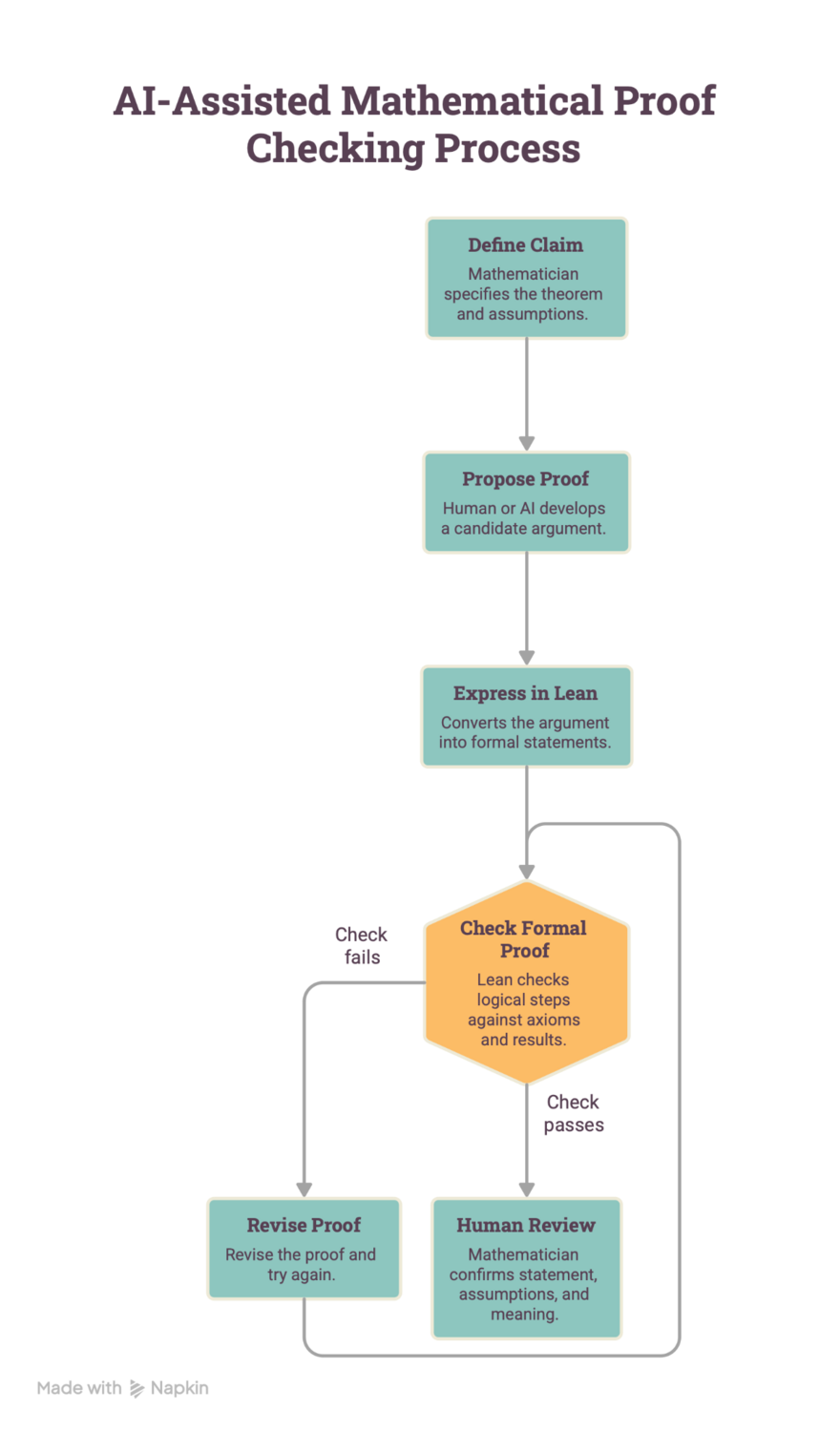
Proof assistants such as Lean let mathematicians express proofs in a formal language. Lean's checking system examines whether each step follows from the definitions and rules being used. AI can help translate or construct those proofs, but Lean itself doesn't need AI to check them.
The Lean documentation also explains why researchers must confirm that a formal statement matches the theorem they intended to prove.
In September 2026, Anthropic reported that Claude helped produce a Lean-checked formalization of Fermat's Last Theorem in 11 days. Andrew Wiles and Richard Taylor had already established the theorem decades earlier. Here, the achievement was converting a complex proof into a form a computer could check.
That could reduce some of the time mathematicians spend checking lengthy arguments and make it easier to examine AI-assisted research.
3. Machine learning can find new mathematical patterns
Think of AI as a way to augment human intuition in math research. Beyond proof checking, AI can help identify patterns that researchers haven't yet noticed.
In a 2021 Nature study, researchers used machine learning to identify a connection between algebraic and geometric properties of mathematical knots. A separate part of the study explored a conjecture involving representations of symmetric groups.
Researchers have also applied machine learning to elliptic curves, objects studied in number theory. A 2024 study examined unexpected patterns called murmurations in data about these curves.
AI helps researchers notice promising relationships. Mathematicians then need to explain those relationships and establish which conclusions follow.
Major AI math breakthroughs in 2025 and 2026
Competition performance, original research, and proof verification test different abilities. Keeping them separate gives a clearer view of the progress. A few recent milestones show the pace of change:
- July 2025: Gemini Deep Think achieved IMO gold-medal standard with five correct solutions out of six.
- May 2026: An OpenAI model produced a counterexample to a longstanding Erdős conjecture about unit-distance pairs. External mathematicians checked the proof. The broader unit-distance problem remains open.
- September 2026: Anthropic announced Claude's formalization of Fermat's Last Theorem.
- October 2026: Harvard reported that AI systems collectively solved all ten problems in the latest First Proof research evaluation. The top system solved nine, but explanations and citations were still weak.
What concerns do mathematicians have about AI?
AI-generated proofs are arriving faster than mathematicians can always read and understand them. That creates questions beyond whether the final answer is correct.
Fields Medalist Terence Tao argued in an October 2026 essay that mathematics needs to place greater value on human understanding as AI produces more proofs. The struggle to find an explanation can reveal ideas that the finished proof alone doesn't communicate.
Credit is another concern. If a model suggests a key idea, researchers and journals need clear ways to describe that contribution. The Annals of Mathematics, for example, requires human authors to take responsibility for their papers and disclose AI-contributed ideas.
Mathematicians will also need to decide how to review an increasing number of AI-assisted results. A formally checked proof can establish logical correctness, but readers still need to understand what the theorem tells them.
How is AI changing math education?
AI is changing math education by giving students personalized explanations and helping teachers create practice exercises and review student work. Students can get help when they're stuck, but they still need to understand how the solutions work. Here’s where AI can help:
AI-powered personalized math learning
Some people learn well through traditional lessons. Others need a different explanation or more practice before a concept clicks. That's where AI tools come into play.
Students, and even teachers, can use AI to create personalized math instruction tailored to individual strengths and weaknesses. It can help with mathematical literature, generate specialized practice problems, walk through the reasoning behind each step, and explain difficult concepts like calculus.
For example, Julius can explain equations and graph results, Wolfram Alpha offers computational math tools, and Photomath can show steps for problems captured by a phone camera.
Teachers can use AI for practice and feedback
Teachers can use AI to draft exercises at different difficulty levels, suggest alternative explanations, and help review common mistakes in student work.
The National Council of Teachers of Mathematics, in its 2024 position statement, recognizes these possibilities while emphasizing the teacher's role. Teachers need to check AI-generated materials and help students question the results.
That means a generated exercise is a starting point. A teacher still decides whether it's mathematically sound and useful for the lesson.
Students can use AI without losing math skills
It's tempting to paste a homework problem into an AI solver and copy the answer. A better approach is to ask for a hint, try the next step yourself, and check the result.
Take the equation 2x + 5 = 13. Subtract 5 from both sides to get 2x = 8, then divide by 2 to find x = 4. Substitute the answer into the original equation: 2(4) + 5 = 13.
AI can explain why each move works or generate a similar question for practice. It can also make mistakes, so checking the work remains part of learning.
AI in applied mathematics and data analysis
Mathematics and data analysis are the backbone of multiple crucial industries. So, as AI makes sense in maths, it’ll eventually help all the related industries. In cybersecurity, mathematical models help analyze security logs to detect patterns and anomalies.
Move into other industries and you see a similar melding of math and AI tools. Data analysts use AI to examine historical figures, explore trends, and build financial models.
Researchers analyze medical and biological data, while engineers use computational methods to study designs such as vehicle aerodynamics.
Mathematics still needs careful interpretation. An incorrect assumption or poor-quality dataset can produce a convincing-looking result that leads to the wrong decision.
The future of AI in mathematics
In 2026, AI in math is already contributing to theorem proving, pattern discovery, and classroom learning. The next challenge is deciding how to use those advances well.
Research teams will need methods for checking AI-assisted results and giving credit. Teachers will need ways to use faster explanations while keeping students engaged with mathematical reasoning. For both groups, understanding the work remains central.
Julius can help with AI-powered math and data analysis
If you're curious about how AI is changing math today, Julius offers a way to try some of these methods yourself.
You can enter or upload a math problem, ask for step-by-step explanations, graph equations, and analyze datasets using a chat-based interface. Julius reports more than two million users worldwide.
Try Julius to work through a problem or explore your data.
Frequently asked questions
How is AI used in math?
AI is used in math to suggest solutions, identify patterns, help formalize proofs, and provide learning support. Researchers use it to explore new questions, while students and teachers use it for explanations, practice problems, and checking work.
Is AI replacing mathematicians?
No, AI isn't replacing mathematicians across the field. It can solve some difficult problems and assist with proofs, but researchers still interpret results, choose worthwhile questions, and decide what new findings mean.
Will AI ever be able to do math?
Yes, AI can already solve many mathematical problems, including some at Olympiad and research level. Its reliability varies by task, and advanced results still need appropriate verification.
What is the relationship between artificial intelligence and math?
Mathematics is the foundation of artificial intelligence as machine learning and neural networks use mathematical principles. AI, in turn, helps mathematicians test ideas, examine data, and develop or check proofs.