

Turn your course notes into explanations, practice questions, and flashcards with Julius: AI Homework Helper in ChatGPT.
You can use ChatGPT for homework help by bringing the material you are studying and asking for a specific next step. That might be an explanation of a difficult passage, feedback on your attempt, or a set of questions to practice before an exam.
Julius: AI Homework Helper adds a workflow for turning that work into study materials you can save. The plugin can help prepare guides, quizzes, worksheets, answer keys, and flashcard files from supplied notes and readings. It can also check quantitative examples and save formatted documents.
This guide follows one sequence: organize your source material, understand the difficult parts, build practice questions, and save a study pack. You can reuse the prompts for different subjects while keeping the content tied to your course.
Open Julius: AI Homework Helper in ChatGPT.
1. Start with the material you need to learn
Install the plugin from its listing and connect your Julius account when prompted. Start a new chat and ask to use Julius: AI Homework Helper. OpenAI's plugin guide also explains how to choose an installed plugin with @.
Provide the assignment question, relevant class notes, or a supported text-based PDF or Word reading. Add the course level, topic, and instructions. If you have already attempted the problem, include your work so the explanation can address where you got stuck.
Starting prompt:
Use Julius: AI Homework Helper with these notes. I am studying introductory English grammar. First identify the topics and any unclear passages. Keep explanations grounded in the notes, and label any extra background you add. Ask about missing information before filling it in.
Check that the material was read correctly. A file upload alone does not establish that a scanned page, handwritten equation, or diagram was interpreted. If a passage is missing, paste the relevant text or provide a clearer source.
2. Ask for an explanation before making a study pack
A useful explanation starts with a specific difficulty. Instead of asking for a chapter summary immediately, identify the part you cannot yet explain yourself.
Explanation prompt:
Explain the difference between active and passive voice using my notes. Give one short example of each. Then ask me to identify the voice in a new sentence and wait for my answer before explaining it.
For a quantitative assignment, include your attempted steps and ask Julius to check the calculation and units. The broader AI math solver workflow is useful when equations or calculations are the main task.
You can also request a hint before a complete solution. Tell Julius how much help you want and which method your class expects. That keeps the explanation aligned with the work you are learning to do.
3. Turn your notes into a focused study guide
Once the difficult parts are clearer, organize the material into something you can review. Define the scope before asking for the guide: one lecture, a chapter, or the topics on an exam outline.
Study-guide prompt:
Create a two-page study guide from these notes. Include key terms, short explanations, one worked example per topic, and common mistakes. Keep the original section names so I can find the source. Flag anything that needs clarification. Save a Word version I can edit and a PDF for review.
Read the guide against the notes. Look for missing qualifications, changed definitions, and extra material that was never part of the course. Ask for corrections before using it to generate the rest of the study pack.
Keep the guide selective. A short document with clear examples is easier to navigate than a second copy of every paragraph in the reading.
An example: one concept, three study formats
Here are two original practice notes for the grammar example:
- In active voice, the subject performs the action: “The team submitted the report.”
- In passive voice, the subject receives the action: “The report was submitted by the team.”
The distinction follows the explanation in Purdue OWL's guide to active and passive voice. The sentences here were written for this example.
Those notes can become a compact guide, a practice question, and a flashcard:
| Study material | Example |
| Guide reminder | Find the subject. Ask whether it performs or receives the action. |
| Practice question | Change “The report was submitted by the team” to active voice. |
| Answer key | “The team submitted the report.” The subject now performs the action. |
| Flashcard | Front: What does the subject do in active voice? Back: It performs the action. |
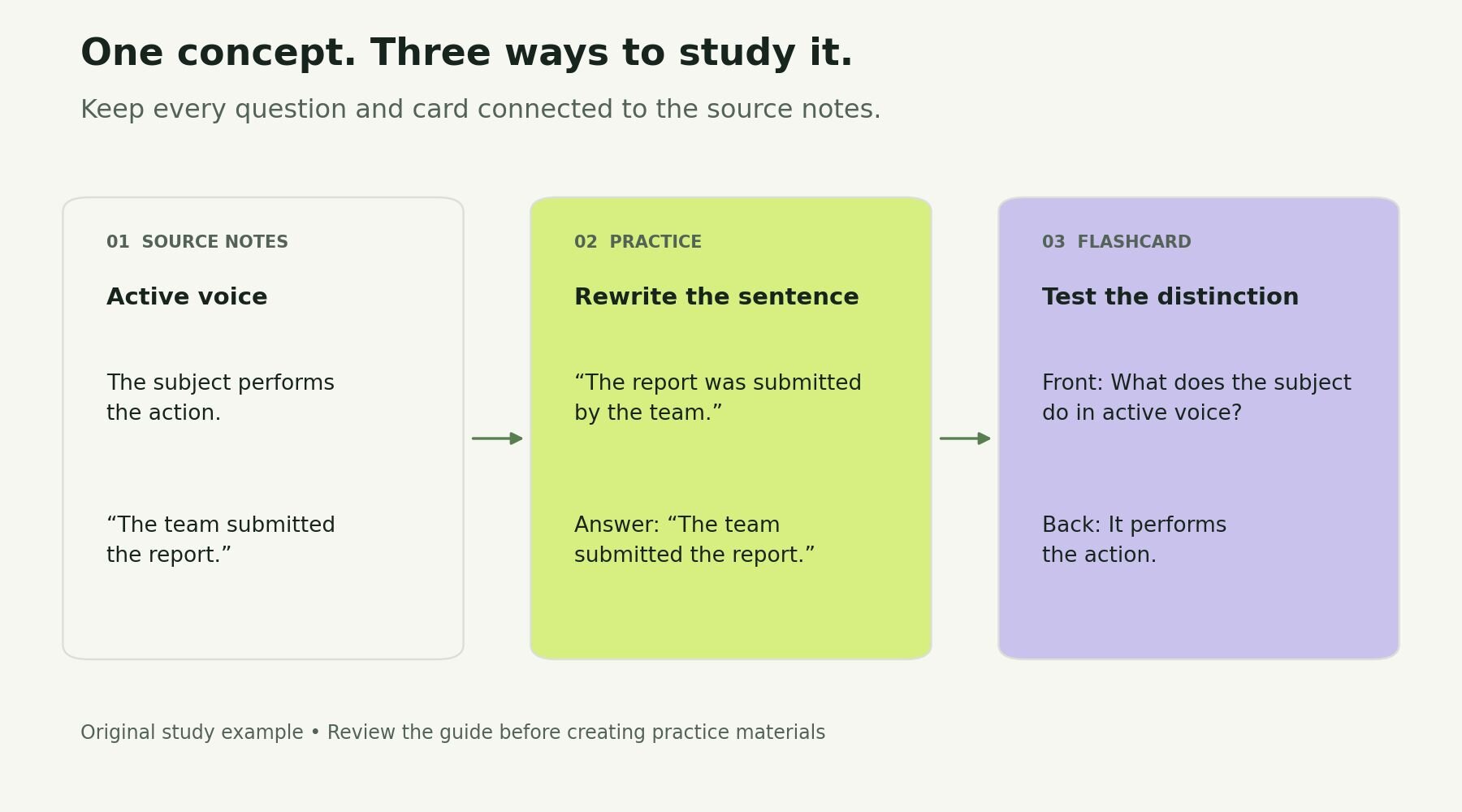
One source concept can become a guide reminder, a practice question, and a flashcard. Original illustrative study materials.
This original study example keeps each output connected to the same source concept.
4. Build practice questions with a separate answer key
Specify the types of questions and where the answers should appear. A quiz with the answer immediately under each question can be inconvenient when you want to try it first.
Practice prompt:
Using the corrected study guide, create 12 practice questions: four definitions, four applications, and four questions about common mistakes. Put the answer key in a separate section with a short explanation for each answer. Use new examples, and identify the source section each question tests.
Check that each question is answerable from the material. Multiple-choice options should have a clear intended answer; a short-answer question should say what a complete response needs to include. For numerical problems, ask Julius to check the answer key with calculations.
After you try the questions, bring back your answers. Ask for feedback on the reasoning and another practice item for each concept you want to revisit. You decide which topics go into the next round.
5. Make flashcards for the facts and distinctions you need
Flashcards work well for a focused question and answer: a term, a definition, a distinction, or a small step in a process. Put longer explanations and multi-step problems in the guide or worksheet.
Flashcard prompt:
Create 15 flashcards from the corrected guide. Use one question per card and a concise answer. Include cards that distinguish commonly confused terms. Save a CSV with Front, Back, and Source section columns, plus a readable text version.
Open the file and inspect the cards. Split any card that asks several questions, and revise answers that lose an important qualification. If you import the CSV into another study application, check its expected column order and formatting.
Julius can create flashcard files or a simple browser study set. Those outputs do not imply automatic spaced-repetition scheduling or a synced learning history.
6. Save a study pack you can use again
Ask for clear filenames and formats that match how you study.
| Material | Useful format |
| Guide you expect to edit | Word |
| Printable worksheet and answer key | |
| Flashcards to organize or import | CSV or text |
| Simple interactive practice quiz | Self-contained HTML |
Final prompt:
Save the corrected guide, practice worksheet, separate answer key, and flashcards with filenames that include the topic and date. Create a one-week review checklist using the topics I missed. Keep the files private.
A review checklist is a plan you can follow; it does not schedule reminders automatically. If you later want to share a finished file, ask Julius to publish that specific resource and provide a public link.
For broader classroom uses, see Julius for education.
Frequently asked questions
Can I use ChatGPT for homework help without asking for the final answer?
Yes. Ask for a hint, an explanation of one step, or feedback on your attempt. You can also request a similar practice question and answer it yourself before asking for feedback.
Can Julius make a study guide from a PDF?
It supports working with text-based PDFs through document processing. Check the extracted material before building a guide. Scanned pages, handwriting, and complex diagrams may need a clearer input or a typed explanation.
Will the questions match my class or exam?
They can be grounded in the notes, readings, and topic list you provide. That does not establish access to your instructor's exam or an official question bank. Include the course level and expected question formats to make practice more relevant.
Which plugin should I use for a difficult equation?
Use Homework Helper for the learning sequence around an assignment: explanation, practice, and study materials. Use Julius: Math Solver & Stats when the main task is a mathematical calculation, graph, or statistical method with a detailed check.
Build your next study pack with Julius
Start with one topic and the notes you already have. Clarify the difficult parts, check the guide, and then create questions and cards you can reuse.