

An investor pitch deck is your best shot at turning a stranger's attention into a meeting with your business. After reading through dozens of decks and the advice behind them, here's how to structure yours.
What is an investor pitch deck?
An investor pitch deck is a short presentation that walks investors through your business idea, your market, and how much money you're asking for. It's built to grab attention fast, since most investors only spend a few minutes on each one before deciding if they want to learn more.
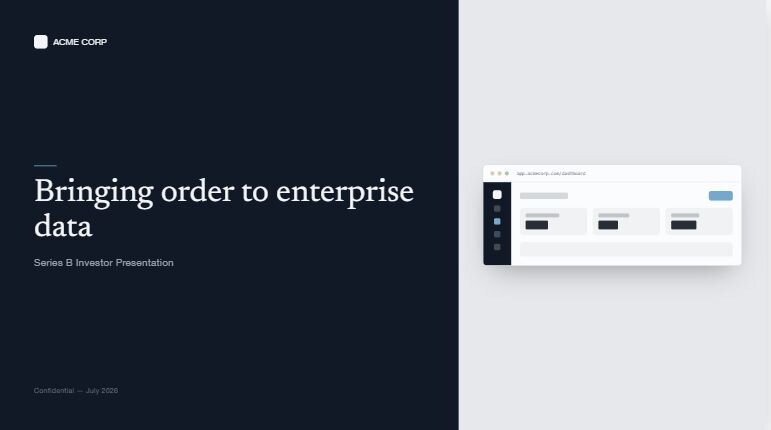
An example title page for a mock investor pitch deck
A pitch deck isn't the same as a full business plan. A business plan goes deep into every detail of your operations, and a pitch deck gives investors just enough to get curious and ask for a meeting.
From what I’ve seen about how founders raise money, the decks that work aren't just a pile of stats. Investors are betting on people as much as numbers, so your deck needs a story that connects the problem, your solution, and why your team is the right one to solve it.
How to create an investor pitch deck: step-by-step
A strong pitch deck follows a clear order that builds your case one slide at a time. Here's a breakdown of the slides investors often expect to see:
1. Define the problem and your solution
Start with the problem you're solving and who feels it most. Investors want a clear picture of the pain point before they hear about your product, so keep this slide focused on the customer's struggle rather than your company.
Once the problem is clear, introduce your solution in plain terms. A short screenshot or demo can help investors picture how it works, and you can save the deeper feature details for later conversations.
2. Size your market
Show investors how big the opportunity is by breaking your market into three parts. Cover your total addressable market, your serviceable addressable market, and your serviceable obtainable market, so investors can see the full opportunity and the realistic slice you can capture first.
I've found it's tempting to lead with the biggest possible number, but grounding your estimate in research and comparable companies can build more trust than an inflated figure.
3. Explain your business model
Walk investors through how your business makes money. Cover your pricing, your direct costs, and the margin you keep on each sale, since this helps investors understand when the business can become profitable.
4. Show proof that people want what you're building
This slide, often called a traction slide, works best when it includes specific numbers rather than vague claims of growth. Depending on your business, that might mean how much revenue you bring in each month, how many people actively use your product, or signed agreements from early customers who plan to buy.
I've noticed founders sometimes skip this slide when they're pre-revenue, but you can still show proof through conversations with potential customers or a working prototype.
5. Address your competition
List the other companies or tools solving this problem today, and explain what makes your approach different. Avoid claiming you have no competition, since investors tend to see that as a sign you haven't done your research.
A simple comparison table can work well here, as long as it's honest about where competitors have an edge too.
6. Introduce your team
Explain why your team is the right one to solve this problem, not just where everyone went to school or worked before. If there's a gap in your team's experience, naming an advisor who fills that gap can help reassure investors.
7. Build your financial projections
Most investors like to see a few years of projected revenue and expenses, along with the assumptions behind those numbers. This gives investors a basis for discussion and shows you've thought through how the business grows over time.
8. Make your ask
Close with a clear ask that covers how much you're raising, the terms you're offering, and how you plan to use the funds. Investors often expect this to come as a percentage breakdown tied to your expenses, so they can see exactly where their money goes.
I've come across decks that build a strong case all the way through, then leave the ask vague or skip it entirely. That can leave investors unsure what you actually want from them, so it's worth spelling out clearly, along with your expected timeline and the milestones you plan to hit with the new funding.
Common investor pitch deck mistakes to avoid
Even a well-researched deck can lose an investor's interest if it stumbles on execution. Here's what to watch for before you hit send:
Overcomplicating slides: Cramming too much text or too many data points onto one slide can bury your point instead of making it. Investors skim fast, so each slide works best when it makes one point clearly.
Making unsupported claims: Saying you have no competition or that your market will hit a certain size without backing it up can raise more questions than it answers. I've found investors respond better to a claim that's grounded in research, even if the number is smaller.
Skipping the "why us" narrative: A deck can nail every other slide and still fall flat if it never explains why your specific team is positioned to win.
Changing the deck for every investor meeting: Reworking your story for each conversation can eat up time you'd rather spend building your company. It also makes it harder to track what worked and what didn't across meetings.
Skipping outside feedback before sending it out: A deck that only you and your co-founders have seen can miss gaps that are obvious to an outside reader. Sharing it with someone outside the company before it goes to investors can catch confusing sections early.
Over-polishing at the expense of substance: A deck that looks too slick can sometimes raise a flag rather than build confidence, since investors may wonder if the design got more attention than the business itself. I'd rather see a founder spend that time sharpening the numbers instead.
💡 Tip: A pitch deck lives or dies by how fast an investor can read a chart. Our data visualization best practices guide covers how to pick the right chart type and cut clutter, so your numbers make their case on their own.
Analyze your data and build your pitch deck, all in one place
Your investor pitch needs solid data behind the market and traction slides, and turning that data into a deck can take as long as finding it in the first place. Julius can help with both steps, from pulling the numbers to putting them on a slide you can send to investors.
Here's how Julius can support your pitch:
Data search: You can ask Julius to search the web for public datasets or pull structured financial data for 17,000+ companies through its Financial Datasets integration, so you can start from a question about your market instead of an upload.
Presentation building: Once your numbers are ready, you can use the Julius AI presentation maker to turn your analysis into slides, so your market and traction data move straight from the chart into your deck.
Direct connections: You can link your own databases like PostgreSQL, Snowflake, and BigQuery, or upload CSV and Excel files, so your projections can reflect live numbers instead of a static export.
Smarter over time: Julius includes a Learning Sub Agent that adapts to your database structure as you work with it, learning table relationships and column meanings, which can help your results stay accurate as you dig deeper into your numbers.
Built-in data visualization: You can ask for bar charts, line charts, or pie charts on the spot, so the charts behind your market and financial slides are ready to present rather than something you build from scratch in another tool.
Ready to build the numbers behind your next pitch? Try Julius for free today.
Frequently asked questions
How long should an investor pitch deck be?
Most investor pitch decks run between 10 and 20 slides. Early-stage decks tend to stay closer to 10 slides, since investors expect a quick, focused story at that stage. Later-stage decks can run longer to cover more traction, financial detail, and team background.
What makes a good investor pitch?
A good investor pitch clearly explains the problem, shows a working solution, and backs up claims with real numbers instead of vague promises. It also tells a story that connects your team to the problem, so investors see why you're the right people to solve it. A clear ask at the end makes it easy for investors to know what you're requesting.
How do you calculate TAM, SAM, and SOM for a pitch deck?
You calculate TAM, SAM, and SOM by narrowing your market from every potential customer down to who you can realistically reach. Total addressable market (TAM) is every potential customer, serviceable addressable market (SAM) is the slice you can serve given your business model, and serviceable obtainable market (SOM) is what you can capture near term.
What should be included in a pitch deck for investors?
A pitch deck for investors should include your problem, solution, market size, business model, traction, competition, team, financial projections, and ask. Each slide builds on the last to show why the problem matters, why your solution works, and why your team can execute it. Close with a clear ask that covers the amount, terms, and how you'll use the funds.