Solve any problem with the best Calculus AI.
Upload your problem and get expert-level tutoring in seconds.
Loved by 2,000,000+ users and trusted by individuals at















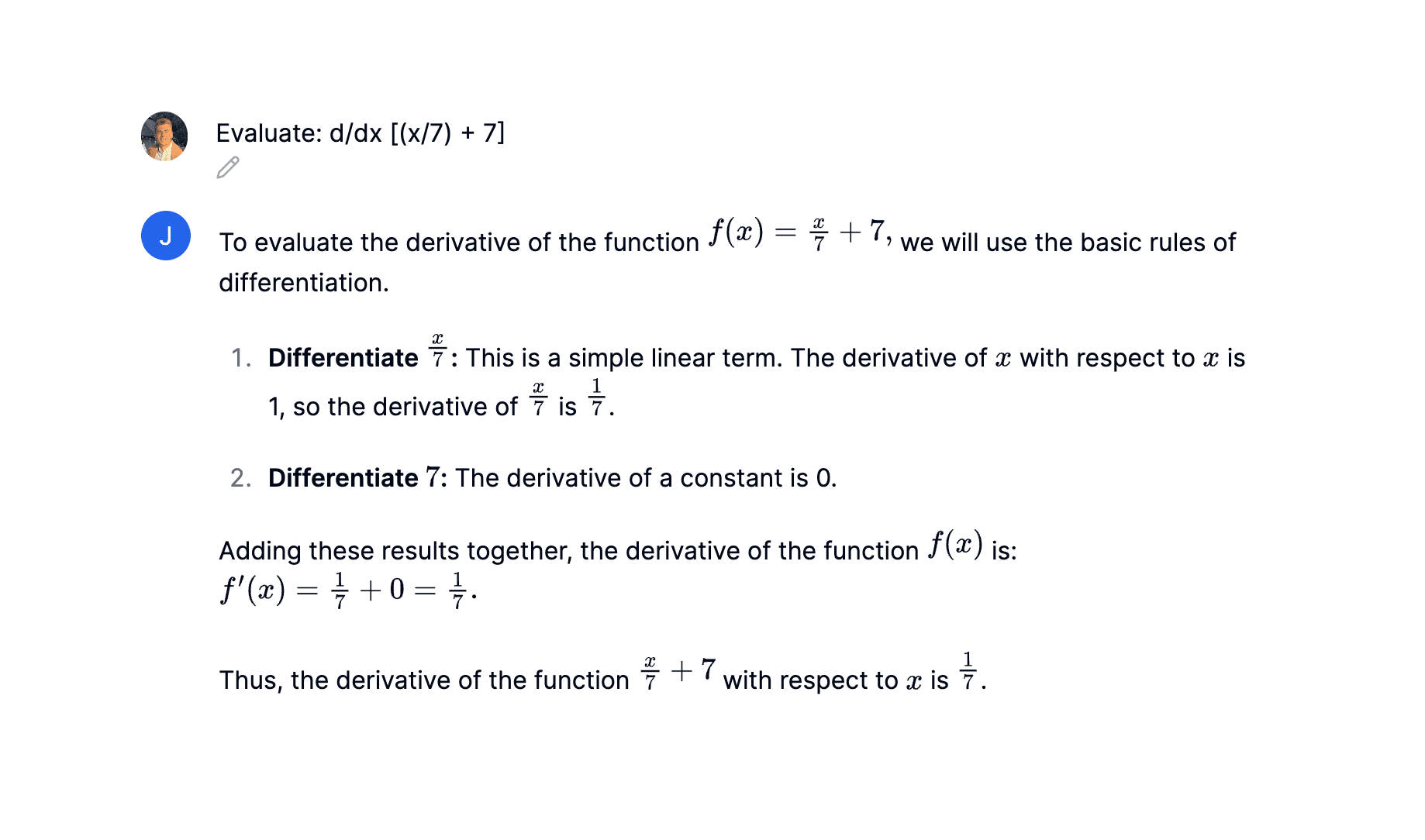

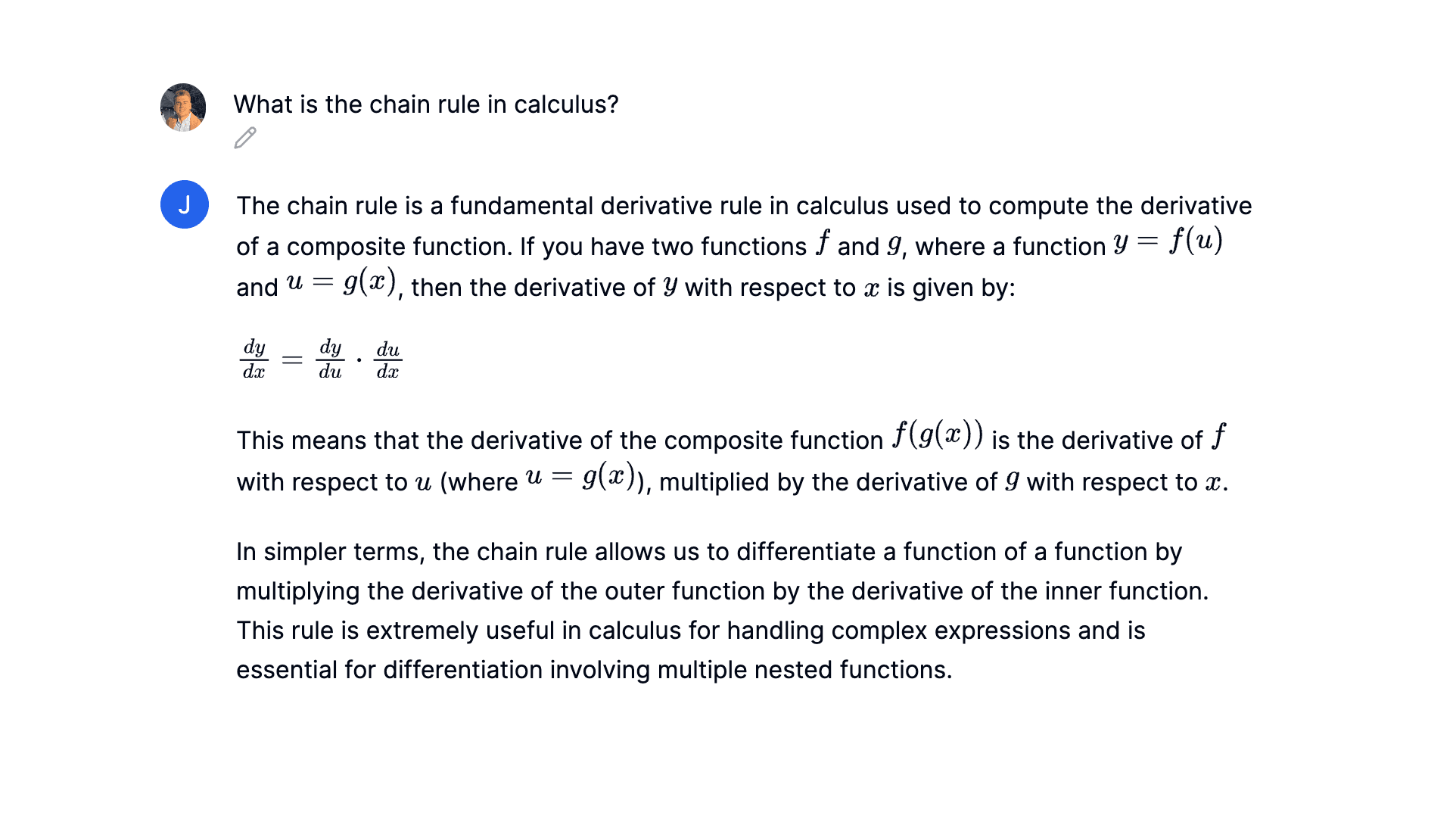
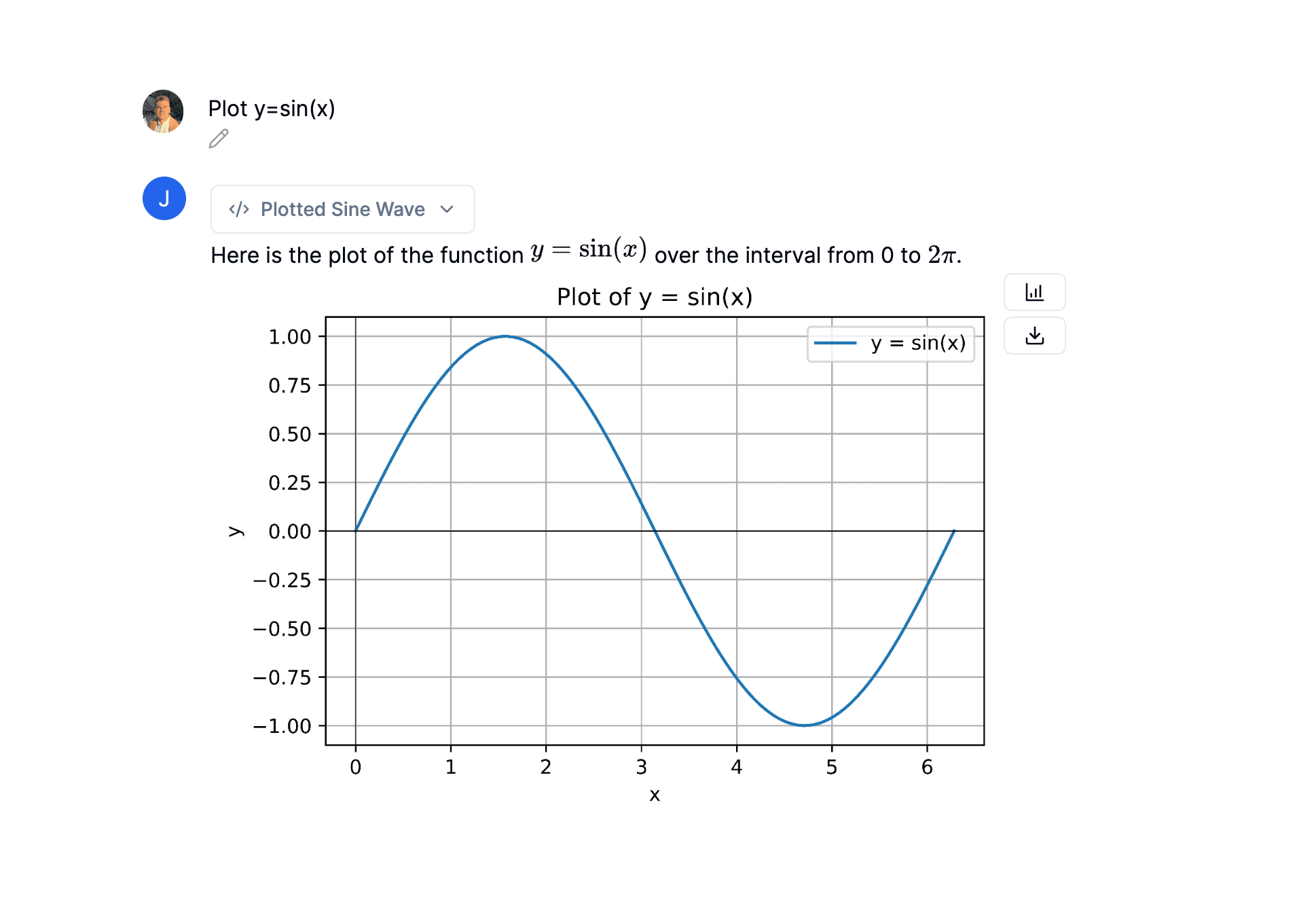
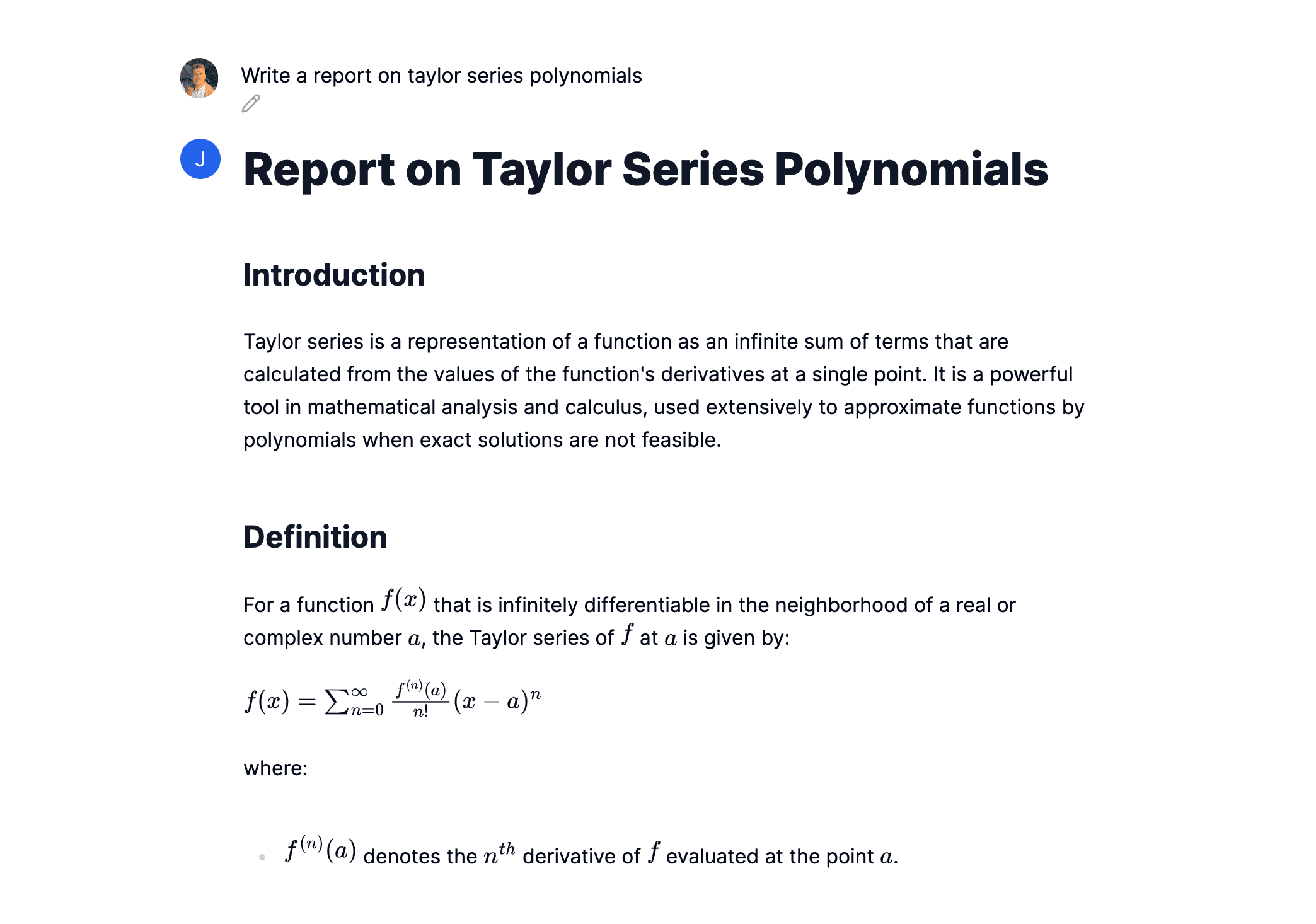
How to solve a calculus problem with Julius
- Sign in to chat, then type or paste your calculus problem, or attach a clear problem image. Include the variable, integral bounds, and any domain restrictions.
- Ask for the method and intermediate steps. For example: “Explain why the chain rule applies and show the inner derivative.”
- Check the answer, ask about any unclear step, and request a similar practice problem.
Worked calculus examples
These instructional examples illustrate the methods and checks to look for; they are not recorded Julius outputs.
Derivative with the chain rule
- Differentiate (x² + 1)³ with respect to x. This is a function inside another function: let u = x² + 1, so the outer function is u³.
- Differentiate the outer function: d(u³)/du = 3u². Differentiate the inner function: du/dx = 2x.
- Multiply: d/dx[(x² + 1)³] = 3(x² + 1)² × 2x = 6x(x² + 1)².
- Check by expanding the original function to x⁶ + 3x⁴ + 3x² + 1. Its derivative is 6x⁵ + 12x³ + 6x, which factors to 6x(x² + 1)².
Common mistake: forgetting the inner derivative 2x. Ask “Why do we multiply by the inner derivative?” Then practice differentiating (2x + 1)³.
Evaluate a definite integral
- Evaluate the integral of x² from 0 to 2. The bounds 0 and 2 specify the interval of integration.
- Use the power rule for an antiderivative: F(x) = x³/3.
- Apply the fundamental theorem of calculus: ∫₀² x² dx = [x³/3]₀² = F(2) − F(0) = 8/3 − 0 = 8/3.
- Check the antiderivative by differentiating: d/dx[x³/3] = x², the original integrand. Since x² is nonnegative on [0, 2], the positive integral also matches the signed-area interpretation.
Common mistake: forgetting to subtract the lower-bound value. Ask “How would the answer change if the lower bound were 1?”
Evaluate a limit
- Find the limit of (x² − 4)/(x − 2) as x approaches 2. Direct substitution gives 0/0, an indeterminate form.
- Factor the numerator: x² − 4 = (x − 2)(x + 2). For x ≠ 2, cancel the common factor to obtain x + 2.
- Take the limit of x + 2 as x approaches 2: the limit is 4.
- Check from both sides: for x = 1.99 and x = 2.01, the original expression equals 3.99 and 4.01, respectively, consistent with the factored expression approaching 4.
The original expression is undefined at x = 2. A limit describes nearby behavior, so a limit of 4 does not assign a value to the original expression at 2. Ask “Why can we cancel x − 2 when finding the limit but not evaluate the original fraction at 2?”
Learn calculus concepts, not just answers
Ask for a hint before the full solution, an explanation of why a method applies, or help identifying the first incorrect step in your work. For the derivative above, try “Explain the inner and outer functions in another way.” Compare the steps with your course materials before using the result.
When choosing an AI calculus tool, compare correct answers, valid steps, stated assumptions, clear explanations, image transcription, and verification. A confident response is not a substitute for checking the mathematics.
Solve calculus problems from a photo
Attach a readable photo or screenshot and ask Julius to transcribe it first. Compare the transcription with the original: check exponents, parentheses, integral bounds, and whether the limit is one-sided.
For an image of the integral above, confirm “integral from 0 to 2 of x² dx” before requesting the method, solution, and differentiation check. If the upper bound was read as 7, reply “The upper bound is 2, not 7; please correct the transcription and recalculate.” Type ambiguous notation directly if needed. Image recognition can make mistakes.
Review prerequisite equations with the Algebra Calculator or visit our AI math solver for other math topics for factoring, expressions, and word problems.


Calculus topics Julius can help explain
Explore the method, assumptions, and checks behind a solution.
Integrals
Find antiderivatives and evaluate definite integrals with their bounds.
Derivatives
Explore rates of change, including the chain rule for composite functions.
Limits
Study nearby behavior, one-sided limits, and points where a function is undefined.
Differential Equations
Work through equations containing derivatives and check initial conditions.
Series & Sequences
Explore sequence patterns, convergence, and when an infinite sum exists.
Optimization Problems
Find candidate maxima and minima, then check endpoints and constraints.