Anthropic: Claude Fable 5.1
Explore demanding reasoning tasks with explicit constraints, source material, and checks on the result.
Available on Pro, Max, Ultra, and Business. Compare plans
Reviewed · Sources
- Best suited to
- Difficult reasoning and complex, multi-step work
- Published context
- 1,000,000 tokens
- Native inputs
- Text and images
- Released
- September 1, 2026
Claude Fable 5.1 pricing
Compare the provider’s API rates with access through Julius.
Prices in USD, reviewed October 13, 2026. API token charges are separate from Julius subscriptions and credits.
What is Claude Fable 5.1?
Claude Fable 5.1 is Anthropic’s model for demanding reasoning and extended agent tasks. It supports a one-million-token context window and work involving documents, spreadsheets, and slides.
Fable is worth considering when a task has several dependencies and an initial result needs deeper scrutiny. In Julius, give it an explicit goal, the source files, and the checks that a finished answer must pass.
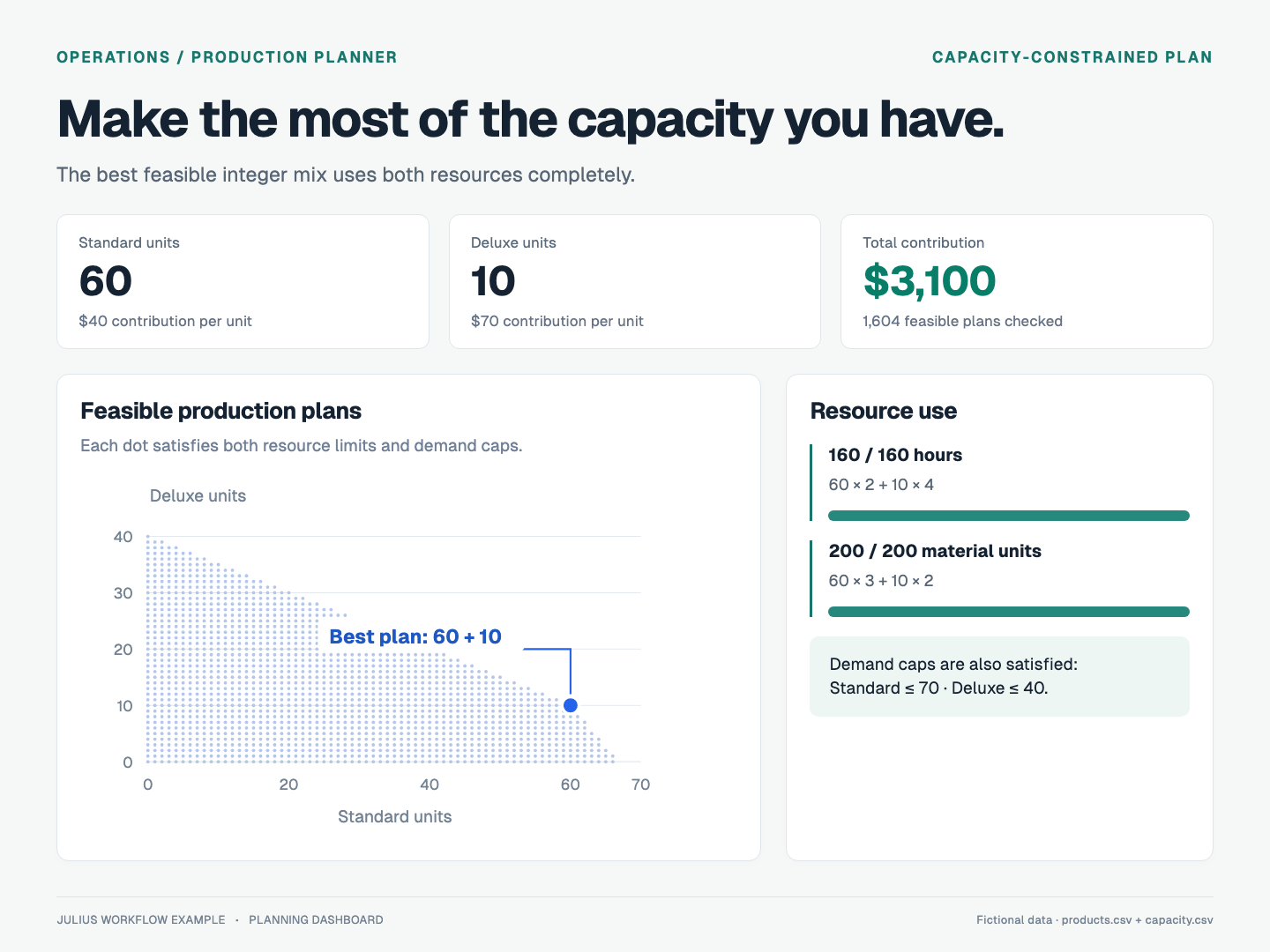
Choose a production mix within two resource limits
A higher contribution per unit does not necessarily produce the best total contribution.
Worked example · Fictional sample data · Expected results calculated from the CSVs
1. Input
Products and resource limits
2. Check
Test feasible whole-unit plans
3. Deliver
A plan within both limits
View the prompt and sample data
Use integer quantities to maximize total contribution, subject to the hours, material, and product-demand limits in these files. Enumerate the feasible plans or use an integer solver, verify both resource constraints, and compare the optimum with an all-Deluxe plan. Show the allocation and explain the tradeoff.
capacity.csv
resource,available
hours,160
material,200
products.csv
product,contribution_per_unit,hours_per_unit,material_per_unit,max_demand
Standard,40,2,3,70
Deluxe,70,4,2,40
These expected results come from the downloadable Python calculations. This example illustrates a workflow; it is not a measured benchmark of Claude Fable 5.1.
Using Claude Fable 5.1 in Julius
Start with your task
The try buttons carry Claude Fable 5.1 into a new chat when your plan includes it. Example buttons also fill the composer with the sample data. Review the prompt, or replace it with your own files and question, before sending.
If the model is unavailable on your plan, Julius explains the access requirement. You can choose another option in the model menu.
Know the boundaries
- It has higher standard API token prices than Sonnet and Opus. Escalate based on the task, rather than assuming the largest model is needed for every question.
- Fable and Mythos have different access arrangements. Julius’s Fable option does not imply access to Anthropic’s separate verification programs.
Model details and official research
Go to the original documentation for specifications, release details, and evaluation methods.
Claude Fable 5.1: frequently asked questions
Is Claude Fable 5.1 available on Julius?
How much does Claude Fable 5.1 cost?
Are Claude Fable 5.1 and Claude Mythos 5.1 the same offering?
Explore other models and research
Read the details, compare tradeoffs, and find another model for your work.