Anthropic: Claude Opus 5.5
Work through sustained research and analysis, with room to inspect the evidence and revise the answer.
Available on Pro, Max, Ultra, and Business. Compare plans
Reviewed · Sources
- Best suited to
- Sustained research, coding, and knowledge work
- Published context
- 1,000,000 tokens
- Native inputs
- Text and images
- Released
- September 22, 2026
Claude Opus 5.5 pricing
Compare the provider’s API rates with access through Julius.
Prices in USD, reviewed October 13, 2026. API token charges are separate from Julius subscriptions and credits.
What is Claude Opus 5.5?
Claude Opus 5.5 is Anthropic’s model for extended coding and knowledge work. It combines a one-million-token context window with adaptive reasoning and text and image understanding.
Try Opus for a project that needs continuity across several steps, such as reading source files, developing an analysis, and explaining the result. Define the deliverable and ask it to identify missing evidence before drafting.
Find the mix shift behind a conversion increase
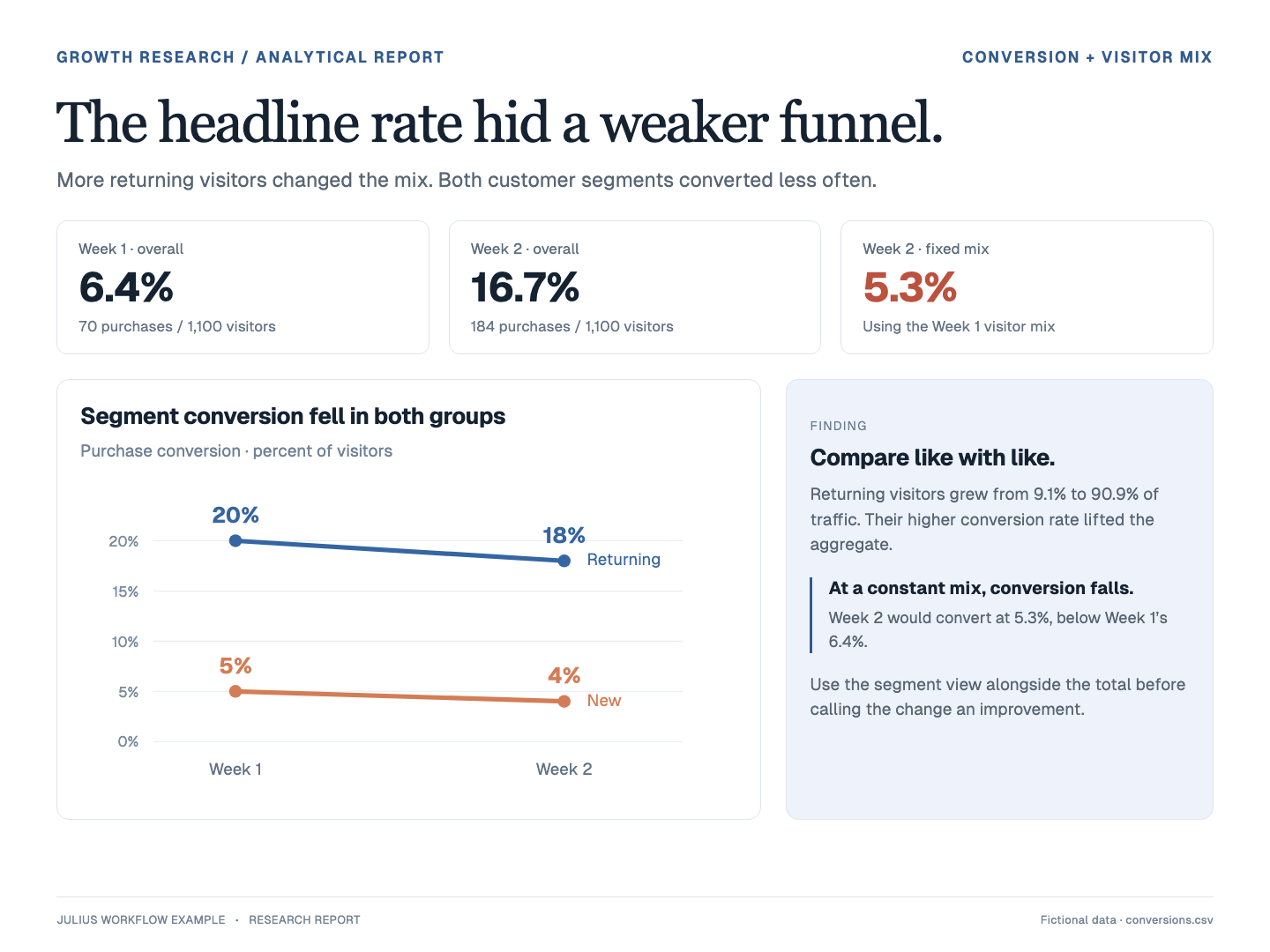
Overall conversion improved, yet both visitor segments performed worse. Can both be true?
Worked example · Fictional sample data · Expected results calculated from the CSVs
1. Input
Visitors and conversions
2. Check
Hold the visitor mix constant
3. Deliver
A fair conversion comparison
View the prompt and sample data
Calculate conversion by week and by visitor segment. Explain whether the overall improvement reflects better within-segment conversion or a change in visitor mix. Recalculate week 2 using week 1 segment weights. Build a comparison chart and a concise review memo. Treat this as observational data, not evidence of causation.
conversions.csv
week,segment,visitors,purchases
1,New,1000,50
1,Returning,100,20
2,New,100,4
2,Returning,1000,180
These expected results come from the downloadable Python calculations. This example illustrates a workflow; it is not a measured benchmark of Claude Opus 5.5.
Using Claude Opus 5.5 in Julius
Start with your task
The try buttons carry Claude Opus 5.5 into a new chat when your plan includes it. Example buttons also fill the composer with the sample data. Review the prompt, or replace it with your own files and question, before sending.
If the model is unavailable on your plan, Julius explains the access requirement. You can choose another option in the model menu.
Know the boundaries
- More reasoning can increase time and credit usage. Use a focused question and a clear stopping point.
- Provider benchmark results depend on tools, prompts, and effort settings. They are not measured performance guarantees for your Julius workflow.
Model details and official research
Go to the original documentation for specifications, release details, and evaluation methods.
Claude Opus 5.5: frequently asked questions
Is Claude Opus 5.5 available on Julius?
How much does Claude Opus 5.5 cost?
When should I choose Opus instead of Fable?
Explore other models and research
Read the details, compare tradeoffs, and find another model for your work.