Anthropic: Claude Sonnet 5.5
A balance of speed and reasoning for everyday analysis, writing, and working through your files.
Available on Pro, Max, Ultra, and Business. Compare plans
Reviewed · Sources
- Best suited to
- Everyday work with a balance of speed and cost
- Published context
- 1,000,000 tokens
- Native inputs
- Text and images
- Released
- September 28, 2026
Claude Sonnet 5.5 pricing
Compare the provider’s API rates with access through Julius.
Prices in USD, reviewed October 13, 2026. API token charges are separate from Julius subscriptions and credits.
What is Claude Sonnet 5.5?
Claude Sonnet 5.5 is Anthropic’s model for work that needs both speed and reasoning. It supports text and image input, a one-million-token context window, and up to 128K output tokens.
Sonnet is a useful starting point for an iterative task: ask a question, inspect the result, and refine it. In Julius, try it for spreadsheet exploration, a first research pass, or a presentation outline before deciding whether the task needs a more intensive model.
Clean a sales export before reporting growth
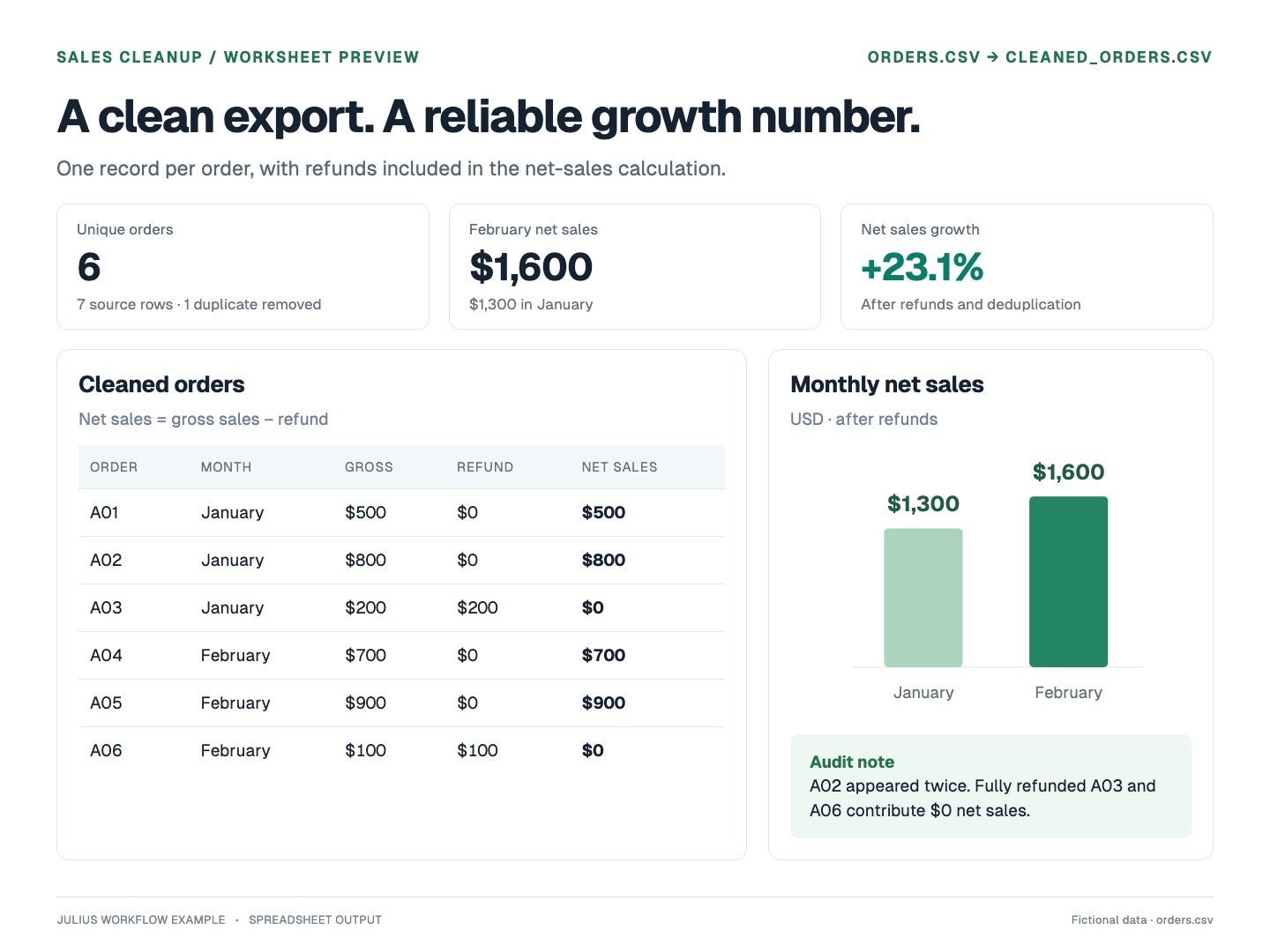
A sales export contains a repeated order and fully refunded purchases. Is February really growing?
Worked example · Fictional sample data · Expected results calculated from the CSVs
1. Input
Orders, including refunds
2. Check
Remove the duplicate order
3. Deliver
Monthly net sales and growth
View the prompt and sample data
Inspect this order export. Remove exact duplicate order records, flag any conflicting duplicates instead of guessing, and subtract refunds once per order. Compare January and February net sales, calculate growth, and create a chart. Include a small audit log explaining each cleanup step.
orders.csv
order_id,month,gross_sales,refund
A01,January,500,0
A02,January,800,0
A02,January,800,0
A03,January,200,200
A04,February,700,0
A05,February,900,0
A06,February,100,100
These expected results come from the downloadable Python calculations. This example illustrates a workflow; it is not a measured benchmark of Claude Sonnet 5.5.
Using Claude Sonnet 5.5 in Julius
Start with your task
The try buttons carry Claude Sonnet 5.5 into a new chat when your plan includes it. Example buttons also fill the composer with the sample data. Review the prompt, or replace it with your own files and question, before sending.
If the model is unavailable on your plan, Julius explains the access requirement. You can choose another option in the model menu.
Know the boundaries
- For especially demanding work, compare a result with Opus or Fable using the same sources and task.
- Model context limits and API pricing describe Anthropic’s service. Julius file handling and credit usage follow Julius’s own product limits.
Model details and official research
Go to the original documentation for specifications, release details, and evaluation methods.
Claude Sonnet 5.5: frequently asked questions
Is Claude Sonnet 5.5 available on Julius?
How much does Claude Sonnet 5.5 cost?
How does Claude Sonnet 5.5 compare with Opus 5.5?
Explore other models and research
Read the details, compare tradeoffs, and find another model for your work.