xAI: Grok 4.7
Explore questions and code-based analysis with reasoning effort you can adjust to the task.
Available on Pro, Max, Ultra, and Business. Compare plans
Reviewed · Sources
- Best suited to
- Reasoning and coding with adjustable effort
- Published context
- 500,000 tokens
- Native inputs
- Text and images
- Released
- September 16, 2026
Grok 4.7 pricing
Compare the provider’s API rates with access through Julius.
Prices in USD, reviewed October 13, 2026. API token charges are separate from Julius subscriptions and credits.
What is Grok 4.7?
Grok 4.7 is a reasoning model from xAI for coding, work with tools, and knowledge tasks. It accepts text and images, returns text, and has a 500,000-token context window.
Use Grok in Julius to explore a question, work through a calculation, or review a piece of analysis. Choose the thinking level that fits the problem, and ask for the evidence behind the answer.
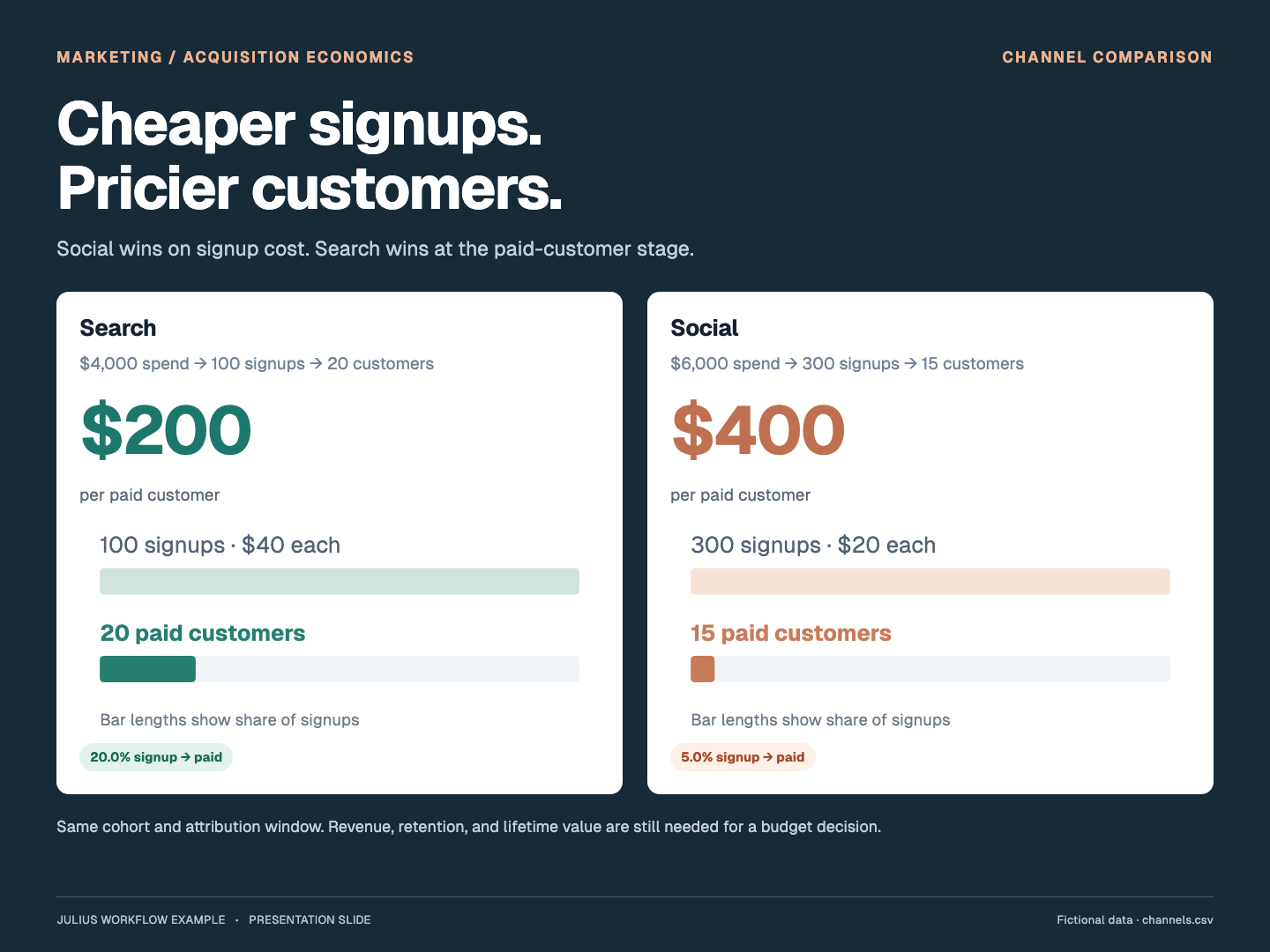
Compare acquisition costs at the paid-customer stage
Social delivers cheaper signups. Does it also deliver cheaper paying customers?
Worked example · Fictional sample data · Expected results calculated from the CSVs
1. Input
Spend, signups, paid customers
2. Check
Use the same cohort and window
3. Deliver
Cost per paying customer
View the prompt and sample data
Compare cost per signup, signup-to-paid conversion, and paid-customer acquisition cost by channel. Assume each channel’s spend, signups, and paid customers refer to the same acquisition cohort and attribution window. Make a comparison chart and a recommendation with limitations. Do not infer lifetime value or profitability from this dataset.
channels.csv
channel,spend,signups,paid_customers
Search,4000,100,20
Social,6000,300,15
These expected results come from the downloadable Python calculations. This example illustrates a workflow; it is not a measured benchmark of Grok 4.7.
Using Grok 4.7 in Julius
Start with your task
The try buttons carry Grok 4.7 into a new chat when your plan includes it. Example buttons also fill the composer with the sample data. Review the prompt, or replace it with your own files and question, before sending.
If the model is unavailable on your plan, Julius explains the access requirement. You can choose another option in the model menu.
Know the boundaries
- Access to Grok in Julius is separate from a Grok or X subscription. Provider tools and entitlements do not automatically transfer.
- A provider’s published output limit and the limits configured by an application can differ. Keep the requested deliverable focused.
Model details and official research
Go to the original documentation for specifications, release details, and evaluation methods.
Grok 4.7: frequently asked questions
Is Grok 4.7 available on Julius?
How much does Grok 4.7 cost?
Does using Grok on Julius require an X subscription?
Explore other models and research
Read the details, compare tradeoffs, and find another model for your work.